
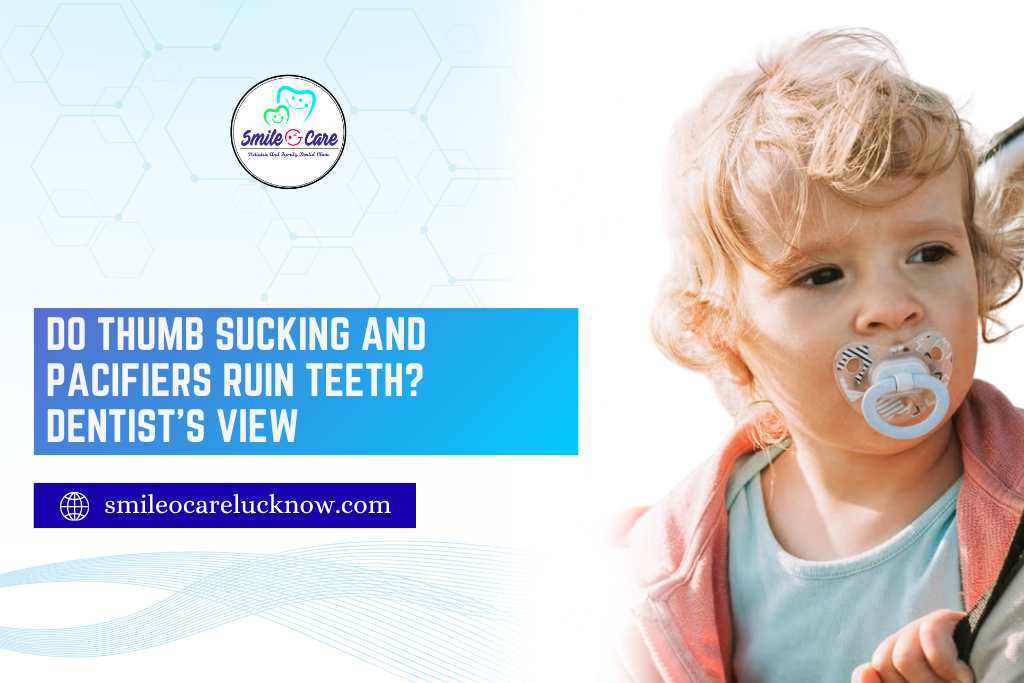
Thumb Sucking and Pacifiers: Does the habit of your child negatively affect his or her smile?
As a parent, you must have noticed your small one soothing himself/herself in a thumb or some favourite pacifier in an instant. It is an instinct, a relaxing reflex and makes babies feel safe and fall asleep. Nevertheless, at a certain level, this cute habit turns out to be a comforting factor and a significant dental issue. You are not looking at a cute stage; you are looking at the base of the jaw structure and the alignment of adult teeth of your child in the future. When the habit is not stopped by the time a person is of an age, it may result in bulging out teeth that are known as buck teeth, speech disability, and huge orthodontic payments. This guide is a direct look through the myths to provide you with a dentist-approved and in-depth look at when these habits prove to be detrimental and just how you can ensure that your child has a growing smile without any permanent damage before it is too late.
Why Children Suckle: The Natural Origin of the Habit?
The habit of sucking thumbs and pacifier use is based on the rooting reflex of a baby. Infants suck their thumbs in the womb long before their birth. Once born, this act gives them a feeling of security and allows them to deal with the world, which may seem to overwhelm them. The majority of pediatric dentists accept that such habits are quite normal and, most of the time, harmless in the case of infants and toddlers. The worry will only start when the habit continues, where the jaw of the child starts to harden, and permanent teeth begin their process towards the surface.
The Tipping Point: When It Becomes a Problem
The age of four is considered to be the Golden Rule of pediatric dentistry. The majority of children will automatically quit sucking their thumbs or pacifiers between the ages of two and four. When the child is still very attached to his or her pacifier or thumb when they enter preschool, it is time to be very attentive. When the permanent front teeth start emerging, which is normally at the age of between five and six years, the repetition of any pressure on the gums may make the bone re-form around the habit. At the competitive school setting in Lucknow, a child can also have low confidence and socialisation due to an early misalignment of the teeth.
The Shape of the Mouth with the Change of the Push
Not only is there the presence of the thumb, but the intensity of the suction. According to Dentists, there are passive and active suckers among children. When a child just sucked his/her thumb, it is not as dangerous as sucking that of a vigorous child. This aggressive movement leaves a vacuum and physical pressure, which causes the upper teeth to move forward and the lower teeth to move back. This may eventually result in an "Open Bite", in which the top and bottom front teeth are not in contact with each other even when the mouth is closed, or a Crossbite, in which the upper jaw becomes too narrow for the lower jaw.
Pacifiers/ Thumbs: Which is the worst?
Pacifiers are the lesser of the evils, in many cases, as far as the dental opinion is concerned. Why? Since you can one day de-pacifier, but you can never de-thumb. The habits related to pacifiers are less difficult to quit due to the fact that the mother has control over the access. In addition, a significant proportion of the modern pacifiers are made in an orthodontic shape, flatter and shaped to resemble the natural shape of the nipple, which exerts a slightly less force on the palate than a hard and round thumb. Nevertheless, when taking excessive hours a day, the two will ultimately cause the same kind of alignment problems.
The Unrecognised Effect of Speech and Swallowing
The harm does not just end with the appearance of the teeth, but it goes on to influence the functionality of the mouth. Thumb sucking can also result in a tongue thrust habit when it is constantly practised. Since the teeth are forced forward, the tongue starts to stick out through the hole when he/she swallows and speaks. This usually leaves one with a lisp or the inability to pronounce the sounds (S), (Z), (T) and (D). Remedying a lisp that is the result of the dentures may necessitate not only a dentist to repair the teeth, but a speech therapist to retrain the tongue. The sooner a lisp is prevented, the better (and less expensive).
Guide of Lucknow Parents: Advice to Quit the Habit
The habit of comfort needs to be broken with the help of patience and using the positive reinforcement strategy instead of punishment. Begin with triggers- does your child suck his thumb when he/she is bored, tired or anxious?
The Sticker Chart: In the case of older children, a reward system based on the number of nights and thumb-free afternoons is a miracle.
The "Nasty" Taste: This is the last option; it is a bitter-tasting nail polish that is recommended by dentists and reminds the person of the habit.
The Soft Bandage or Thumb Guard: This is a soft bandage or a thumb guard that should be used at night to interrupt the unconscious reflex when sleeping.
The Trade of the Big Kid: This means that you should encourage your child to exchange his/her pacifiers in place of some special toy or visit a local favourite location in your town, such as the Lucknow Zoo.
At what age do you see a Pediatric Dentist?
In case you observe that the upper teeth of your child begin to tilt forward, or you notice that it has a gap and bites down, you need to make an appointment. A child dentist will be able to examine the skeletal effects of the habit. We may at times fit a small, innocent device, the so-called Palatal Crib, which is a painless appliance, placed over the mouth-roof. This device renders the physically uncomfortable sucking of the thumb and does not allow the thumb to form the suction which moves the teeth. It is an extremely efficient method of quitting the habit within a few months.
Long-term Advantages of the Early Intervention
These habits before the age of five will be basically interceptive orthodontics. When the problem in the jaw position is not solved when the child is very young, it is far easier and less painful than attempting to move permanent teeth that have already become stuck in the incorrect position. Headgear and braces cost a lot of money, and now is the time to avoid an open bite in your child. More to the point, it helps your child develop a functional bite, enabling them to chew and talk well.
A Healthier Future, One Step at a Time
Thumb sucking and pacifiers are a sweet part of being a baby, but they shouldn't follow your child into elementary school. As a parent, your goal is to help them move from these early comforts to healthy habits that support their growth. By staying alert and acting before the permanent teeth arrive, you are giving your child the best gift possible: a healthy, confident smile that lasts a lifetime. Every child is different, and while breaking the habit might take a few weeks of effort, the result is a beautiful smile that functions perfectly. Our clinic in Lucknow is here to help you and your child through this transition with kindness and expert care.